
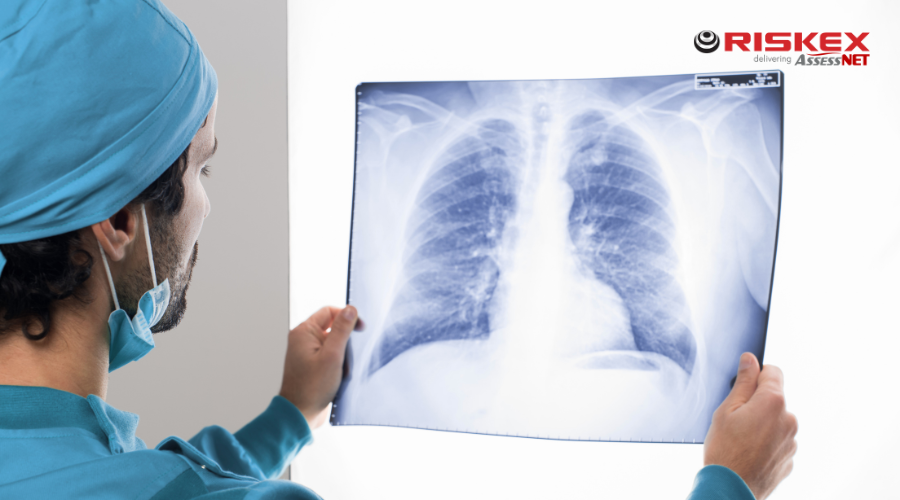
According to HSE’s latest occupational lung disease statistics (published 20 November 2025), there are an estimated 11,000 lung disease deaths each year linked to past exposure at work.
That estimate is dominated by diseases with long latency: COPD (35%), non-asbestos lung cancer (23%), asbestos-related lung cancer (20%), and mesothelioma (20%).
Because many occupational lung diseases take decades to develop, today’s deaths largely reflect historic controls and exposure standards. However, the same causative agents (dusts, fumes, vapours and gases) still exist across many workplaces and remain an on-going hazard.
The wider burden is also significant. Based on Labour Force Survey (LFS) estimates averaged across 2022/23–2024/25, there are 22,000 new cases each year of breathing/lung problems people believe were caused or made worse by work, and 49,000 new or long-standing cases among those who worked in the last 12 months (with 135,000 among those who have ever worked).
Types of Occupational Lung Disease
Occupational lung diseases include but are not limited to:
- Work-related asthma
- Chronic Obstructive Pulmonary Disease (COPD)
- Work-related lung cancer
- Pneumoconiosis
- Silicosis
- Asbestos-related disease
- Extrinsic allergic alveolitis
Core legal duty
By law, employers must prevent or adequately control exposure to substances hazardous to health using site- and process-specific measures (not generic assumptions). Effective control depends on understanding where exposure is generated, who is exposed (including contractors), and how exposure varies by task, time, and environment.
Practical risk reduction measures
Risk reduction/ mitigation methods include:
- Competent CoSHH assessments and scheduled reviews
- Exposure monitoring / surveys (to confirm controls work in practice)
- Substitution and alternative processes (eliminate or reduce airborne generation)
- Less hazardous materials (where feasible)
- Information, instruction and training (including correct RPE use where needed)
- Engineering controls: enclosures and effective local exhaust ventilation
- PPE/RPE as a last resort (with face-fit, maintenance and supervision where applicable)
Occupational health monitoring and exposure limits
The priority is confirming that exposures are controlled below applicable Workplace Exposure Limits (WELs), and that controls remain effective when processes, substances, equipment, or workload changes. Long-latency disease risk is driven by repeated exposure over time, so “short duration” tasks still matter if they’re frequent or poorly controlled.
Health surveillance and occupational health input are particularly important where respiratory sensitisation or progressive disease is possible, and where early symptoms may be subtle.
How can AssessNET help manage these risks?
The AssessNET CoSHH and SDS module helps you to understand and assess the risks associated with specific activities and exposure levels, enabling you to review current control measures and identify safer alternatives where available. It also supports PPE recommendations and emergency procedures based on SDS data. The in-built SDS manager allows you to tailor CoSHH assessments to your operations, improving visibility of risks created by specific products and how to control them.
Built with efficiency at its core, AssessNET’s SDS management system will notify CoSHH assessment owners and recommend reviews when substance changes are made and a new edition of the SDS is published on the platform. Combined with AssessNET’s Task Manager, linkages to EH40, glove permeation data and location-specific registers, AssessNET can provide a robust and collaborative approach across your organisation.
This can be used in conjunction with our BI Data Analytics tool, helping you prioritise higher-risk areas and identify the operations/products generating the greatest health risk exposure.
Other AssessNET modules to support safe systems of work
- Permit to Work – Enables employees, temporary workers and contractors to follow controlled processes, ensuring access to areas and tasks aligns with authorisation and competence.
- Risk Assessments – Carry out workplace activity risk assessments to evaluate hazards and refine controls across tasks and environments.
- Method Statement – Create bespoke method statements per activity, clarifying task steps, key hazards, and required controls.
- Training Management – Maintain real-time training status, confirm competence for specific tasks, and identify gaps or expired records.